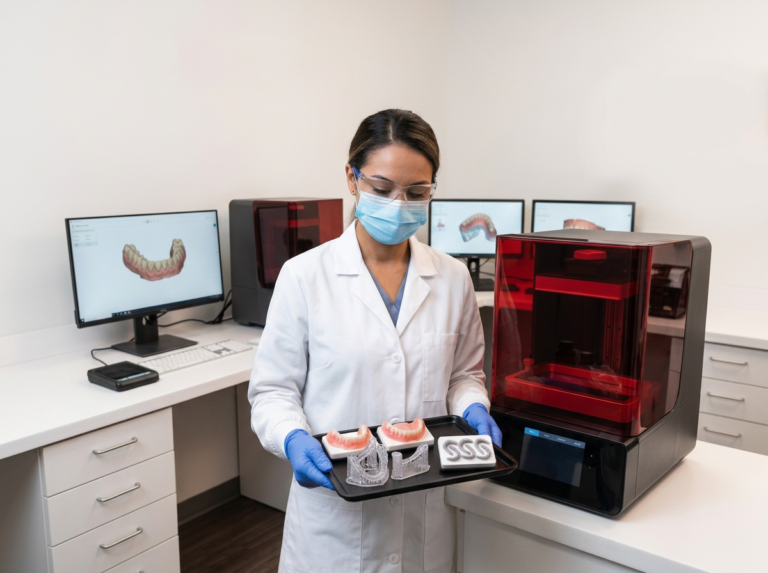
3D Printing In-House: What Dental Teams Need to Know About Staff Safety
Insights from Professor Laurie Walsh
A huge thank you to Professor Laurie Walsh for joining Dental Innovations for our recent webinar, “3D Printing In-House: A Primer for Dental Staff Safety.”
Professor Walsh brought his extensive knowledge and experience to an increasingly important topic for dental practices. As more practices bring 3D printing in-house to produce surgical guides, models, splints and temporary restorations, understanding the potential workplace risks is just as important as understanding the benefits.
If you missed the webinar, we strongly encourage you to watch the recording. Professor Walsh provides practical, evidence-based guidance on identifying hazards, reducing staff exposure and creating safer 3D printing workflows within the dental practice.
3D Printing In-House: A Primer for Dental Staff Safety
Presented by Professor Laurie Walsh
Proudly supported by Dentsply Sirona

Ventilation Matters More Than You Think
One of the key messages from Professor Walsh’s presentation was the importance of controlling exposure at the source.
3D printing can release volatile organic compounds (VOCs) and ultrafine particles (UFPs), particularly during printing and post-processing. In poorly ventilated environments, these contaminants can accumulate and increase potential exposure for staff.
Good room ventilation, local exhaust systems and enclosed printing solutions can all help minimise exposure and create a safer working environment.
Learn more:
Safe Work Australia – Airborne contaminants and workplace controls
PPE Is Important – But It’s the Last Line of Defence
Another important takeaway was the need to look beyond personal protective equipment.
Gloves, masks and eye protection have an important role to play, particularly when handling uncured resin or during cleaning and post-processing. However, PPE sits at the bottom of the Hierarchy of Controls.
Where possible, practices should first look at ways to eliminate or reduce the hazard through engineering and environmental controls. This might include enclosed printing, washing and curing systems, effective ventilation and local exhaust.
For tasks where exposure remains possible, appropriate nitrile gloves, eye protection and respiratory protection should be selected and used correctly.
Learn more:
Safe Work Australia – Managing WHS Risks
Don’t Overlook Post-Processing
The printer itself isn’t the only consideration.
Professor Walsh highlighted the importance of looking at the entire 3D printing workflow, including washing, curing, cleaning and handling.
Isopropyl alcohol (IPA), commonly used during cleaning and post-processing, can produce vapours that may cause irritation, headaches, dizziness and drowsiness when exposure isn’t adequately controlled.
Enclosed washing systems, appropriate ventilation and correct storage can help reduce potential exposure.
Small Changes Can Make a Big Difference
Some of the practical steps practices can consider include:
- Position printers away from staff workstations where possible.
- Ensure adequate air exchange or local exhaust ventilation.
- Use enclosed washing and curing systems where possible.
- Wear appropriate nitrile gloves when handling uncured resins.
- Review the Safety Data Sheets (SDS) for all printing materials and chemicals.
- Ensure materials are stored correctly.
- Train everyone involved in the workflow, not just the person operating the printer.
- Review the complete printing and post-processing workflow regularly.
Continuing to Support Independent Practices
At Dental Innovations, our webinars are designed to give independent dental practices access to practical, evidence-based information that can help teams stay informed, safe and prepared for the future.
The growth of in-house 3D printing presents exciting opportunities for dental practices, but as Professor Walsh demonstrated, those opportunities need to be balanced with a clear understanding of workplace safety.
Thank you again to Professor Laurie Walsh for sharing his expertise with our members, and to Dentsply Sirona for supporting this valuable educational session.
Missed the webinar?
Take 30 minutes to hear directly from Professor Laurie Walsh and learn what your practice should consider when introducing or expanding in-house 3D printing.